Common Mistakes in Battery Pack Assembly: Why Nickel Strip Selection Matters
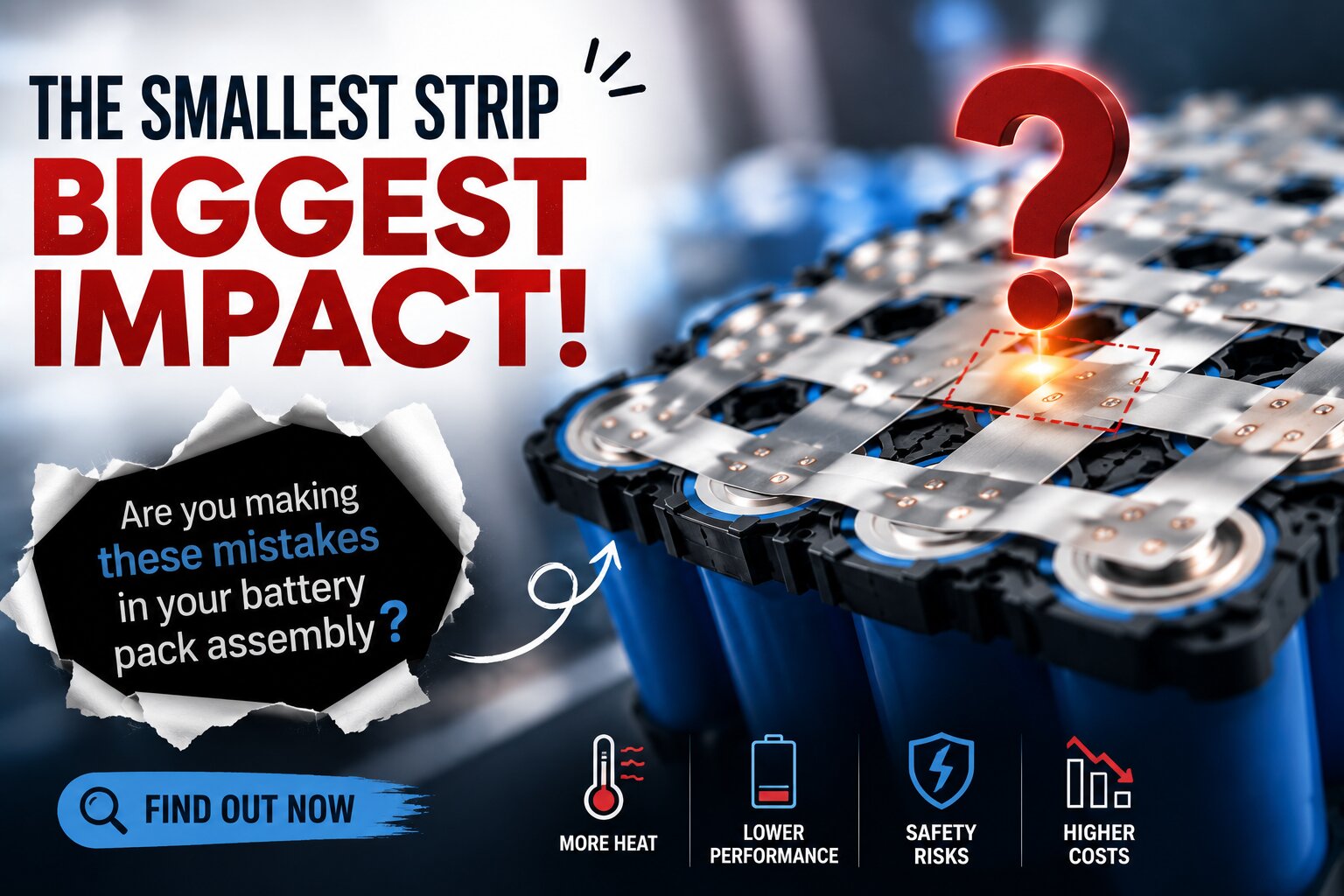
Common Mistakes in Battery Pack Assembly: How the Wrong Nickel Strip Selection Can Cost You Performance, Safety, and Money
Introduction
When people think about battery pack performance, they often focus on the battery cells, the Battery Management System (BMS), or charging technology. While these components are undoubtedly important, one critical element is frequently overlooked—the nickel strip.
It may seem like a small metal connector, but the nickel strip is the backbone of every lithium-ion battery pack. It carries current between cells, influences heat generation, determines electrical efficiency, and directly impacts the battery's lifespan and safety.
Surprisingly, many battery pack failures are not caused by defective cells. They result from poor nickel strip selection or incorrect assembly practices.
Whether you're an OEM, battery pack manufacturer, EV startup, engineer, or procurement professional, understanding nickel strip selection can help you avoid expensive mistakes, warranty claims, and dissatisfied customers.
In this guide, we'll explore the most common mistakes made during battery pack assembly and explain how choosing the right nickel strip can significantly improve battery performance and reliability.
---
Why Nickel Strip Selection Matters More Than You Think
Every lithium-ion battery pack relies on nickel strips to connect individual cells into a complete battery system.
Their responsibilities include:
* Carrying electrical current safely
* Maintaining low electrical resistance
* Dissipating heat efficiently
* Creating reliable spot-weld connections
* Providing long-term mechanical stability
A poorly selected strip increases resistance, generates unnecessary heat, wastes energy, and reduces battery efficiency.
Simply put:
A premium battery cell cannot perform at its best if the nickel strip is poorly designed or incorrectly selected.
---
Mistake #1: Choosing Strip Thickness Based Only on Price
One of the biggest mistakes manufacturers make is selecting the thinnest strip available to reduce costs.
At first glance, this saves money.
In reality, it creates multiple problems.
Thin strips:
* Carry less current
* Heat up quickly
* Increase voltage drop
* Reduce battery efficiency
* Shorten battery life
Imagine trying to transport heavy traffic on a narrow road. Congestion is inevitable.
Electric current behaves similarly.
If the strip is too thin for the required current, resistance increases dramatically.
What Happens?
* Higher operating temperatures
* Lower efficiency
* Faster battery degradation
* Spot weld failures
* Increased risk of thermal issues
---
Mistake #2: Ignoring Current Carrying Capacity
Not every battery pack has the same power requirements.
A battery for an LED light has completely different current demands than:
* Electric scooters
* Electric bikes
* Power tools
* Solar storage systems
* Industrial battery packs
Yet many manufacturers use identical nickel strips across different applications.
This is a serious design mistake.
Every strip should be selected according to:
* Continuous current
* Peak current
* Cell configuration
* Load profile
* Expected operating temperature
Choosing a strip without current calculations often results in overheating and premature failure.
---
Mistake #3: Using Low-Quality Nickel-Plated Steel Instead of Pure Nickel
One of the most common industry shortcuts is replacing pure nickel with nickel-plated steel.
Although they look similar, their performance is completely different.
Pure Nickel
* Low electrical resistance
* Better conductivity
* Excellent corrosion resistance
* Stable long-term performance
* Ideal for lithium battery packs
Nickel-Plated Steel
* Higher resistance
* More heat generation
* Corrosion after prolonged use
* Reduced efficiency
* Lower lifespan
Many buyers unknowingly purchase nickel-plated steel because it is cheaper.
Initially, the battery appears to work normally.
Problems begin after months of charging cycles when resistance increases and heat starts damaging the pack.
Always verify the material before purchasing.
---
Mistake #4: Selecting Incorrect Strip Width
Thickness isn't the only factor.
Width matters just as much.
If the strip is too narrow:
* Current density increases
* Heat concentration rises
* Weld strength decreases
* Resistance becomes higher
If it's unnecessarily wide:
* Material cost increases
* Spot welding becomes difficult
* Assembly complexity rises
Selecting the proper width ensures an optimal balance between electrical performance and manufacturing efficiency.
---
Mistake #5: Poor Spot Welding Compatibility
Even the highest-quality nickel strip can fail if it isn't compatible with your spot welding process.
Common welding issues include:
* Weak weld nuggets
* Burned battery terminals
* Loose strip connections
* Inconsistent weld penetration
Incorrect combinations of strip thickness and welding parameters can damage expensive battery cells during production.
Every strip should be tested with the actual welding machine before mass production.
---
Mistake #6: Ignoring Heat Generation
Heat is the biggest enemy of lithium-ion batteries.
Poor nickel strip selection causes excessive resistance.
Higher resistance means:
Current → Resistance → Heat
As temperatures rise:
* Battery capacity decreases
* Cell ageing accelerates
* Internal pressure increases
* Safety risks become higher
Efficient current flow keeps temperatures lower and extends battery life.
---
Mistake #7: Buying Based Only on Price
Many purchasing teams compare only the cost per kilogram.
This often leads to poor decisions.
The cheapest strip may result in:
* More warranty claims
* Higher maintenance costs
* Increased product returns
* Lower customer satisfaction
* Brand reputation damage
Saving a few rupees during production can cost thousands later in replacements and service.
The smartest manufacturers evaluate **total lifecycle cost**, not just purchase price.
---
Mistake #8: Not Testing Before Mass Production
Some manufacturers skip validation to speed up production.
This is risky.
Before approving any nickel strip, manufacturers should test:
* Current carrying capability
* Weld strength
* Temperature rise
* Voltage drop
* Corrosion resistance
* Mechanical durability
* Charging cycle performance
Testing helps identify issues before products reach customers.
---
Mistake #9: Using the Same Nickel Strip for Every Battery Pack
Every battery pack is different.
For example:
* E-bike batteries demand higher discharge currents.
* Solar storage systems operate for long durations.
* Medical devices prioritize reliability.
* Power tools require frequent high-current bursts.
* Industrial equipment often works in harsh environments.
Using one standard strip across all applications compromises performance.
Battery design should always determine nickel strip selection—not convenience.
---
Mistake #10: Choosing an Inexperienced Supplier
The supplier plays a critical role in battery reliability.
A reliable supplier offers:
* Consistent material quality
* Accurate dimensions
* Certified raw materials
* Stable production processes
* Technical support
* Quality inspection reports
An unreliable supplier may provide inconsistent thickness, poor material composition, or substandard manufacturing quality, leading to unpredictable battery performance.
---
How to Select the Right Nickel Strip
Before placing your next order, ask these questions:
✔ Is it pure nickel or nickel-plated steel?
✔ What current will the battery pack handle?
✔ Is the strip thickness suitable?
✔ Is the width optimized?
✔ Has it been spot-welding tested?
✔ Can it withstand long-term charging cycles?
✔ Does the supplier provide quality certifications?
✔ Has the strip been tested under real operating conditions?
If any of these questions remain unanswered, it's worth pausing before moving forward.
---
The Hidden Cost of Choosing the Wrong Nickel Strip
Many battery failures don't happen immediately.
They develop gradually.
Customers may notice:
* Reduced backup time
* Longer charging periods
* Battery overheating
* Lower driving range in EVs
* Frequent battery replacements
* Unexpected shutdowns
By the time these symptoms appear, the damage has already been done.
In many cases, the root cause traces back to something as simple as an improperly selected nickel strip.
---
Final Thoughts
A nickel strip may look like one of the smallest components inside a lithium-ion battery pack, but its impact is enormous.
The right strip improves efficiency, reduces heat, strengthens weld quality, extends battery life, and enhances overall safety. The wrong one can lead to overheating, voltage loss, premature failures, expensive warranty claims, and unhappy customers.
If you're building battery packs for electric vehicles, energy storage systems, industrial equipment, or any other lithium-ion application, don't treat nickel strip selection as an afterthought. It deserves the same attention as choosing quality battery cells or a reliable BMS.
Because in battery manufacturing, reliability isn't determined by one major component—it's built through hundreds of small decisions made correctly.
And choosing the right nickel strip is one of the most important decisions you'll make.
---
Frequently Asked Questions (FAQs)
1. Why is nickel strip selection important in lithium-ion battery packs?
Nickel strips connect battery cells and carry electrical current throughout the pack. Choosing the correct strip improves conductivity, reduces heat generation, enhances safety, and extends battery life.
2. What is the difference between pure nickel and nickel-plated steel?
Pure nickel offers lower electrical resistance, better corrosion resistance, and more reliable long-term performance. Nickel-plated steel is cheaper but typically generates more heat, has higher resistance, and may corrode over time.
3. How do I choose the correct nickel strip thickness?
The ideal thickness depends on your battery pack's current requirements, cell configuration, and application. A strip that is too thin can overheat, while one that is too thick may complicate spot welding and increase costs.
4. Can the wrong nickel strip reduce battery life?
Yes. Incorrect nickel strip selection can increase resistance and heat, which accelerates cell ageing, reduces efficiency, and shortens the overall lifespan of the battery pack.
5. Which industries benefit from high-quality nickel strips?
High-quality nickel strips are essential for electric vehicles (EVs), e-bikes, energy storage systems (ESS), solar batteries, power tools, medical devices, consumer electronics, and industrial battery packs where safety and performance are critical.
Introduction
When people think about battery pack performance, they often focus on the battery cells, the Battery Management System (BMS), or charging technology. While these components are undoubtedly important, one critical element is frequently overlooked—the nickel strip.
It may seem like a small metal connector, but the nickel strip is the backbone of every lithium-ion battery pack. It carries current between cells, influences heat generation, determines electrical efficiency, and directly impacts the battery's lifespan and safety.
Surprisingly, many battery pack failures are not caused by defective cells. They result from poor nickel strip selection or incorrect assembly practices.
Whether you're an OEM, battery pack manufacturer, EV startup, engineer, or procurement professional, understanding nickel strip selection can help you avoid expensive mistakes, warranty claims, and dissatisfied customers.
In this guide, we'll explore the most common mistakes made during battery pack assembly and explain how choosing the right nickel strip can significantly improve battery performance and reliability.
---
Why Nickel Strip Selection Matters More Than You Think
Every lithium-ion battery pack relies on nickel strips to connect individual cells into a complete battery system.
Their responsibilities include:
* Carrying electrical current safely
* Maintaining low electrical resistance
* Dissipating heat efficiently
* Creating reliable spot-weld connections
* Providing long-term mechanical stability
A poorly selected strip increases resistance, generates unnecessary heat, wastes energy, and reduces battery efficiency.
Simply put:
A premium battery cell cannot perform at its best if the nickel strip is poorly designed or incorrectly selected.
---
Mistake #1: Choosing Strip Thickness Based Only on Price
One of the biggest mistakes manufacturers make is selecting the thinnest strip available to reduce costs.
At first glance, this saves money.
In reality, it creates multiple problems.
Thin strips:
* Carry less current
* Heat up quickly
* Increase voltage drop
* Reduce battery efficiency
* Shorten battery life
Imagine trying to transport heavy traffic on a narrow road. Congestion is inevitable.
Electric current behaves similarly.
If the strip is too thin for the required current, resistance increases dramatically.
What Happens?
* Higher operating temperatures
* Lower efficiency
* Faster battery degradation
* Spot weld failures
* Increased risk of thermal issues
---
Mistake #2: Ignoring Current Carrying Capacity
Not every battery pack has the same power requirements.
A battery for an LED light has completely different current demands than:
* Electric scooters
* Electric bikes
* Power tools
* Solar storage systems
* Industrial battery packs
Yet many manufacturers use identical nickel strips across different applications.
This is a serious design mistake.
Every strip should be selected according to:
* Continuous current
* Peak current
* Cell configuration
* Load profile
* Expected operating temperature
Choosing a strip without current calculations often results in overheating and premature failure.
---
Mistake #3: Using Low-Quality Nickel-Plated Steel Instead of Pure Nickel
One of the most common industry shortcuts is replacing pure nickel with nickel-plated steel.
Although they look similar, their performance is completely different.
Pure Nickel
* Low electrical resistance
* Better conductivity
* Excellent corrosion resistance
* Stable long-term performance
* Ideal for lithium battery packs
Nickel-Plated Steel
* Higher resistance
* More heat generation
* Corrosion after prolonged use
* Reduced efficiency
* Lower lifespan
Many buyers unknowingly purchase nickel-plated steel because it is cheaper.
Initially, the battery appears to work normally.
Problems begin after months of charging cycles when resistance increases and heat starts damaging the pack.
Always verify the material before purchasing.
---
Mistake #4: Selecting Incorrect Strip Width
Thickness isn't the only factor.
Width matters just as much.
If the strip is too narrow:
* Current density increases
* Heat concentration rises
* Weld strength decreases
* Resistance becomes higher
If it's unnecessarily wide:
* Material cost increases
* Spot welding becomes difficult
* Assembly complexity rises
Selecting the proper width ensures an optimal balance between electrical performance and manufacturing efficiency.
---
Mistake #5: Poor Spot Welding Compatibility
Even the highest-quality nickel strip can fail if it isn't compatible with your spot welding process.
Common welding issues include:
* Weak weld nuggets
* Burned battery terminals
* Loose strip connections
* Inconsistent weld penetration
Incorrect combinations of strip thickness and welding parameters can damage expensive battery cells during production.
Every strip should be tested with the actual welding machine before mass production.
---
Mistake #6: Ignoring Heat Generation
Heat is the biggest enemy of lithium-ion batteries.
Poor nickel strip selection causes excessive resistance.
Higher resistance means:
Current → Resistance → Heat
As temperatures rise:
* Battery capacity decreases
* Cell ageing accelerates
* Internal pressure increases
* Safety risks become higher
Efficient current flow keeps temperatures lower and extends battery life.
---
Mistake #7: Buying Based Only on Price
Many purchasing teams compare only the cost per kilogram.
This often leads to poor decisions.
The cheapest strip may result in:
* More warranty claims
* Higher maintenance costs
* Increased product returns
* Lower customer satisfaction
* Brand reputation damage
Saving a few rupees during production can cost thousands later in replacements and service.
The smartest manufacturers evaluate **total lifecycle cost**, not just purchase price.
---
Mistake #8: Not Testing Before Mass Production
Some manufacturers skip validation to speed up production.
This is risky.
Before approving any nickel strip, manufacturers should test:
* Current carrying capability
* Weld strength
* Temperature rise
* Voltage drop
* Corrosion resistance
* Mechanical durability
* Charging cycle performance
Testing helps identify issues before products reach customers.
---
Mistake #9: Using the Same Nickel Strip for Every Battery Pack
Every battery pack is different.
For example:
* E-bike batteries demand higher discharge currents.
* Solar storage systems operate for long durations.
* Medical devices prioritize reliability.
* Power tools require frequent high-current bursts.
* Industrial equipment often works in harsh environments.
Using one standard strip across all applications compromises performance.
Battery design should always determine nickel strip selection—not convenience.
---
Mistake #10: Choosing an Inexperienced Supplier
The supplier plays a critical role in battery reliability.
A reliable supplier offers:
* Consistent material quality
* Accurate dimensions
* Certified raw materials
* Stable production processes
* Technical support
* Quality inspection reports
An unreliable supplier may provide inconsistent thickness, poor material composition, or substandard manufacturing quality, leading to unpredictable battery performance.
---
How to Select the Right Nickel Strip
Before placing your next order, ask these questions:
✔ Is it pure nickel or nickel-plated steel?
✔ What current will the battery pack handle?
✔ Is the strip thickness suitable?
✔ Is the width optimized?
✔ Has it been spot-welding tested?
✔ Can it withstand long-term charging cycles?
✔ Does the supplier provide quality certifications?
✔ Has the strip been tested under real operating conditions?
If any of these questions remain unanswered, it's worth pausing before moving forward.
---
The Hidden Cost of Choosing the Wrong Nickel Strip
Many battery failures don't happen immediately.
They develop gradually.
Customers may notice:
* Reduced backup time
* Longer charging periods
* Battery overheating
* Lower driving range in EVs
* Frequent battery replacements
* Unexpected shutdowns
By the time these symptoms appear, the damage has already been done.
In many cases, the root cause traces back to something as simple as an improperly selected nickel strip.
---
Final Thoughts
A nickel strip may look like one of the smallest components inside a lithium-ion battery pack, but its impact is enormous.
The right strip improves efficiency, reduces heat, strengthens weld quality, extends battery life, and enhances overall safety. The wrong one can lead to overheating, voltage loss, premature failures, expensive warranty claims, and unhappy customers.
If you're building battery packs for electric vehicles, energy storage systems, industrial equipment, or any other lithium-ion application, don't treat nickel strip selection as an afterthought. It deserves the same attention as choosing quality battery cells or a reliable BMS.
Because in battery manufacturing, reliability isn't determined by one major component—it's built through hundreds of small decisions made correctly.
And choosing the right nickel strip is one of the most important decisions you'll make.
---
Frequently Asked Questions (FAQs)
1. Why is nickel strip selection important in lithium-ion battery packs?
Nickel strips connect battery cells and carry electrical current throughout the pack. Choosing the correct strip improves conductivity, reduces heat generation, enhances safety, and extends battery life.
2. What is the difference between pure nickel and nickel-plated steel?
Pure nickel offers lower electrical resistance, better corrosion resistance, and more reliable long-term performance. Nickel-plated steel is cheaper but typically generates more heat, has higher resistance, and may corrode over time.
3. How do I choose the correct nickel strip thickness?
The ideal thickness depends on your battery pack's current requirements, cell configuration, and application. A strip that is too thin can overheat, while one that is too thick may complicate spot welding and increase costs.
4. Can the wrong nickel strip reduce battery life?
Yes. Incorrect nickel strip selection can increase resistance and heat, which accelerates cell ageing, reduces efficiency, and shortens the overall lifespan of the battery pack.
5. Which industries benefit from high-quality nickel strips?
High-quality nickel strips are essential for electric vehicles (EVs), e-bikes, energy storage systems (ESS), solar batteries, power tools, medical devices, consumer electronics, and industrial battery packs where safety and performance are critical.